
The ultimate teaching technique
Feb 14, 2012
UPDATE: I no longer agree with any of the following. It remains on my blog as a warning against hubris. June, 2016
Maybe it's just me, but I seem to be encountering an awful lot of people railing against 'progressive' teaching methods of late (see this for an example.) There seems to some sort of consensus that all schools are bastions of constructivist theory in action and that seldom, if ever, are teachers allowed to waffle from the front. Sadly, my experience is that many teachers still spend far too much time standing at the front of their classes talking at students. Why does this happen despite the widely held wisdom that 80% of the time in lessons should be spent with students getting on with independent work? Well, my view is that it's a damn sight easier to just pitch up and drone on. It requires a good deal more preparation to get a class working independently like a well-oiled learning machine.This is not to say that there is not a time and a place for 'teacher talk': there absolutely is. Whenever we want students to learn large amounts of information the most effective and efficient tactic can be the 'traditional' approach of direction instruction. For those wanting to find out more, I've written about it here.
But, you may be relieved to hear, this isn't the only approach to the imparting of knowledge. My absolute favourite way to teach is using Home and Expert groups. If you have a large quantity of wonderful new information that students need to learn and don't fancy subjecting them to death by Power Point or perpetrating some other passive, teach lead thought crime, the Home/Expert method may be for you. The material you wish students to learn must be divided in into five discrete 'bits' with students required to become 'experts' on one of these five areas. Each member of the expert group is then responsible for taking back whatever it is they've learned to their home group who then have to synthesise the entirety of the material in a manner of your (or their) choosing. Everyone is required to work at all times, otherwise the home groups will be unable to complete their challenge and the miscreant responsible for this failure can be publicly lambasted.
Kids learn enormous amounts from this activity: it develops skills of oracy and of turn taking; they also learn predominantly from each other. Your are not involved in any way other than as a facilitator, and as such, it is a serious, über-constructivist, Ofsted pleaser.Although he calls it ‘jigsawing’, Phil Beadle says this is “the ultimate of all teaching techniques”. I’ve also heard it called ‘snowballing’ and it probably goes by other monikers as well, but I’ve always called it Home and Expert Groups and when it works it is a thing of beauty, wonderful to behold.
Phil Beadle[i]
The main thing is to ensure the groupings and movement work with military precision. I’ve worked with teachers who approach this very successfully on an impromptu basis, but if you’re trying it for the first time I’d recommend some serious advance planning. One way to approach this is to give each student several different groups to which they belong and corresponding seating plans.
This might mean that in class of 30 students you would have five groups of six students. Let’s make these colour groups:
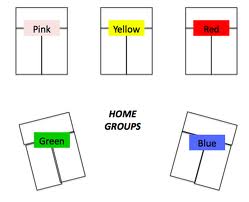
These are our ‘home’ groups. Home groups are all given the same task e.g. summarise Act 2 of Romeo and Juliet or produce a guide to cell division or whatever it is you want. Clearly, this is too big a task to complete in the hour available so we need to move students into expert groups. Let’s make these shape groups:

These groupings have several potential uses. Firstly, if students know in advance that they are, say a green pentagon then they’ll know exactly where to move when you say, right – move to your expert groups. Also, you can work out groupings based on ability, team skills, personality types, gender and so on. The possibilities are only limited by your ability to think up different ways to organise them.
In order to minimise the amount of movement, you might want to inform students that they need to sit in their expert (shape) groups as they enter the room. Then, once you consider they’ve had sufficient time to digest the source material you can blow a whistle or signal time in some other, less piecing way and have every swap to their home (colour) groups to share their findings and work on whatever task it is you've set them. My advice here is to give students less time than you think they'll need. Experience suggests that the time required to complete group activities increases in direct proportion to the amount of time they given.
The most important information students need to know is that their expert group is the only group dealing with the vitally important information which they are privy to and that if they are not all working hard to make sense of it, they’ll be empty handed and exposed as a work-shy oik when reporting back to their home group.
The very best thing about this way of teaching is that it all happens without your direct involvement. You're left free to roam the room giving feedback as and when appropriate, engaging in high quality conversations about the learning which is quite patently unfolding before your happy eyes. Result.
If you doubt that this is a better way to approach the dissemination of knowledge, try it. Compare how much students subsequently know after teaching this way and after engaging in some direct instruction. You may just find yourself surprised.
Related posts
Total teaching: every lesson is groupwork Effective groupwork
The Learning Spy Substack is a sharp, provocative dispatch from the front lines of education, where ideas are tested, myths are challenged, and nothing is taken for granted.
Join me on Substack